
Undone
Sarah Perry
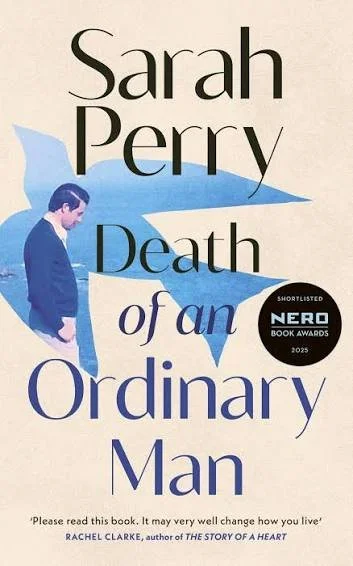
Death of an Ordinary Man (Vintage, 2026);
pbk, £11.99
Sometimes a word troubles me and won’t leave me alone… it’s as if it has a life of its own. Try as I might I can’t quite pin the emotional resonance of the word to the substance of its utterance. Most of the time, though not always, it’s part of a quotation I have half remembered or read. I sound out possible sentences, even replay different scenarios in my mind but the context which gave flesh to the word eludes me; and because of this, pure frustration mounts. It’s like not being able to put your hands on a title you need for teaching, frantically searching shelves and book stacks for it, going from room to room, and feeling that some poltergeist has maliciously moved it from where you know you have left the book. This might well be an age-related thing, but because the word has taken up residence in my mind, I can’t shake it off.
Of late, the word ‘undone’ haunts me. Not ‘undone’ as it relates to everyday activity or inactivity, as in ‘your laces are undone’ or ‘your button has come undone’, but nearer perhaps to that line from Macbeth that suggest the weight of tragedy to come… ‘What is done cannot be undone’. Maybe even nearer to Isaiah’s proclamation in the King James Bible, which I was made to memorise as a young child: ‘Then said I, Woe is me! for I am undone… for mine eyes have seen the King, the Lord of hosts.’ That feeling of utter ruinous, helplessness – that undone-ness -- is what I think I am trying for.
It started with my reading Sarah Perry’s Death of an Ordinary Man, an account of Perry’s father-in-law, David, dying of oesophagus cancer, witnessed at close hand as she and her husband Rob nursed him. Death of an Ordinary Man is one of the few books I’ve read that focuses the dying, rather than the death of a loved one and the grieving process that comes after. Consequently, it’s also a stark reminder of the way of all flesh. The commonplace set of situations that accompany David’s dying – the pained vulnerability of a life gradually laid still on a bed; the incontinence that comes with a failing body; the mental withdrawal; the feelings of love, helplessness, bewilderment, as well as the guilt and resentment, that accompany the all-consuming palliative care required to make the invalid as comfortable as can be… is just emotionally exhausting for both narrator and reader. Perry’s narrator says at one point, ‘I’d become frightened of him, and ashamed of my fear’, and ‘if I turned to look I’d see my selfishness and impatience, my childish inability to drive; that is was clear to everyone, and most painfully to myself, that I wasn’t equal to the task of caring.’ Anyone but anyone who has been through similar situations will know how much this rings true. And while I didn’t have the same relationship that Perry had with David, I can certainly remember being so afraid of my father lying on the hospital bed… wanting to bolt — to be anywhere but in the room where he lay dying.
Perry brings all her skills as a fiction writer to her task, though her narrator’s omniscience in the early part of the memoir, claiming to know what David was doing and thinking when alone at home, sat rather oddly with a careful insistence that she should not presume to speak for David when asked about resuscitation instructions. Yet this oddity didn’t stand in the way of my being so taken by the book, and might speak to the structural difference between Perry as a person outside the text, and Perry as a narrator of Death of an Ordinary Man. David’s character is rendered in vivid and bold strokes: his shy and retiring demeanour, never wanting to draw attention to himself or his ill health; his delight at the circus or the cakes iced to look like fly agaric mushrooms; his sense of mischief; his laughter, ‘Heh!Heh!Heh!’; his catch phrases, ‘sometimes I get in a muddle’; his deeply held Christian faith and unshowy affection all make this figure someone any reader would warm to. Furthermore, he is depicted as an ordinary man, and these are ordinary people… so when this small family of three fall vertiginously into a dark place, I felt undone by it.
In many ways, Death of an Ordinary Man, is as much about the writing — as well as the story — of David’s dying; the doing as much as the undoing. To Perry’s narrator’s credit, she doesn’t duck this but addresses the issue of writing head on. In the middle of the book, when her husband turns to her and says. ‘You’re going to write about this, aren’t you?’, she replies simply, ‘Yes’. We are then told what passes through her mind: ‘I understood that already I’d begun to form images and paragraphs out of what was happening to David; that I watched him not only with love’s frightened attention, but with the inquisitive eye of a magpie.’ Such a response also begs the question, why write? Why put something that takes place off-stage for most not in the medical profession in plain view; why make us focus on death out of time? The book begins as it means to go… with the startling sentence, ‘My father-in-law David, who’d soon begin to die, was waiting by the doughnut stand on Yarmouth seafront…’ The hourglass running down its sand grains does so continuously, even before David is rendered an invalid: he ‘had no idea time was short’, he really ‘ought to remember it for the rest of his life, which is to say for a little less than two months.’
To our everyday blissful or wilful ignorance, Perry’s narrator replies, ‘Sometimes I find I’m angry, because this ought to have been familiar wisdom to me, as familiar as knowing that for example a pregnant woman will frequently be sick. In the aftermath, seeking out stories not of grief but of dying, I saw that to refuse food — placidly, obstinately, and without hunger — is common and unremarkable in the last days of life.’ The response to the question of why write is, to my mind, not simply about showing how one may die with love and dignity (and the book addresses that beautifully) but also how to find a language that is adequate to the experience. In a different time and age, we might have turned to religion to help us… but now we live in a secular age, or have a secular disposition.
So Death of an Ordinary Man seems to ask, in times of real crisis, can acts of devotion bear witness to our capacity to love, to be human? Many individuals in the account attend to the ill far beyond the call of duty: the nurses who attend to the soon-to-bereaved family needs as much as the patient; Emmanuel, who quietly attends to David at night to give the family some respite; Robert, who is so careful with his father — ‘thinking about how to be his son’ and ‘still maintaining his old familiar way of speaking’ — and the Baptist priest whose prayers, bible readings and hymns offer succour. Even David, who still retains his ‘David-ness’ despite his failing health also plays his part. These ordinary everyday acts of simple kindness and virtue are nothing less than acts of grace.
And Perry’s narrator attends to the everyday quotidian as if it were also a sacred devotional exercise. She quotes from Delphine Horvilleur’s Living with Our Dead, ‘“The role of the storyteller… is to stand by the gate to ensure it stays open.…” So I took up my post by an opening gate and have stood there ever since. What else am I supposed to do?’ Devotional acts — in whatever secular or religious forms they take — offer an attentive watchfulness, echoing the inward routines of faith and prayer that we are familiar from Christianity, but are also present in other religious traditions (though the latter is not really touched on in the book). Perry’s narrator writes, ‘This watchfulness teaches me the kind of acquiescent patience which has always eluded me… so I say to my soul: “be still, and wait without hope.”’ With its Biblical quotations, and excerpts from hymn lyrics, Death of an Ordinary Man reaches out for a state of grace even when all around are being undone. David’s faith holds him steadfast, God’s reply to Isaiah holds him, ‘For I the Lord thy God will hold they right hand, saying unto thee, Fear not; I will help thee.’ Given my own religious upbringing, those Biblical sayings have retained their emotional resonance even though the material context and substance are now lost to the winds.
Death of an Ordinary Man has been called a memoir but I’d like to think of it as akin to a long essay… or at least ‘essayistic’ where the writing of it opens out into profound questions that exceed any one personal life story. The book wears its learning very lightly but it is driven by an overwhelming need to ask those weighty metaphysical questions; it moves and shimmers with the narrator’s voice grappling with what that experience might mean or signify. Death of an Ordinary Man’s desire to confront dying, to find a language to deal our living with death is, to my mind, the book’s most precious gift. The image with which the book ends gestures towards the mystery of living and dying… which is just what it is and should be.