
Capturing the wave...
‘‘There's never been so much photography on view, and most of it is bad.’ [1]
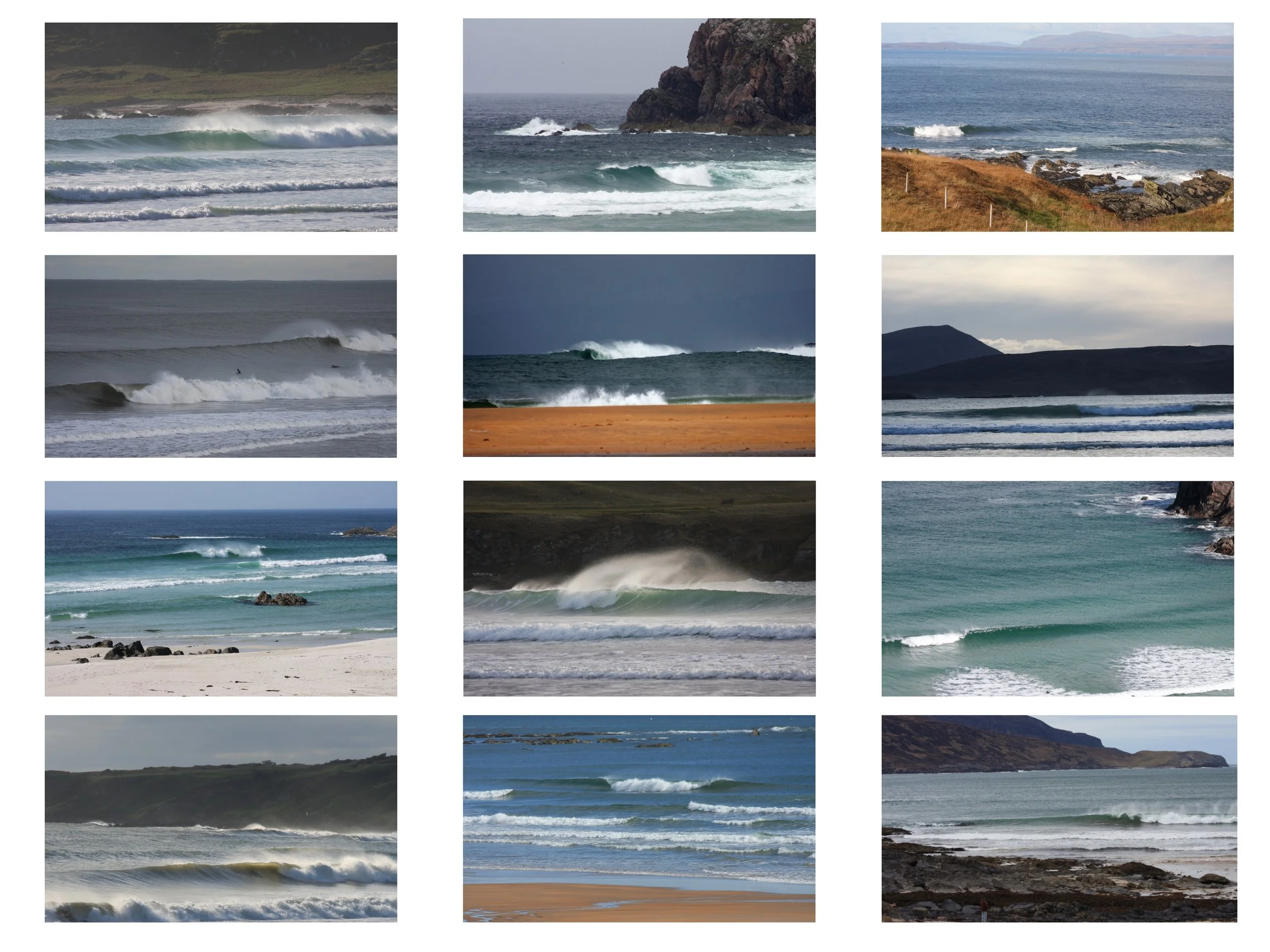
The internet is awash with surf photography. At time of writing, on Instagram you'll find 22.4 million posts with the hashtag "#surfing", 2.9 million with the hashtag ‘#surfphotography’, 772,000 with ‘#surfingphotography’ and 462,000 with ‘#surfphoto’. Many of the images in these posts are action shots of people surfing, whether taken from the land by a photographer using a telephoto lens, from the water by some brave soul with a camera in a waterproof housing, or captured by the surfers themselves, using miniature surfboard-mounted cameras like the ubiquitous GoPro. A significant proportion of them, though, are simply photos of breaking waves. Some of these pictures are skilfully shot and jaw-droppingly beautiful, but many of them are also distinctly average. In spite of their technical and artistic shortcomings, however, or perhaps because of them, it's these average pictures of empty waves that fascinate me the most.
Let's get one thing straight right at the start: I'm very definitely not a surf photographer. I'm just a surfer who, like thousands of other surfers, enjoys taking photos of surf. If that sounds like splitting hairs, it isn't—the difference is vast. To make it as a surf photographer —a professional surf photographer that is—you need to commit. It's not enough just to be able to combine artistic flair with a deep knowledge of both photography and surfing, you also need a monastic level of devotion to the cause. You have to be prepared to drop everything at a moment's notice to chase a rumour of a good swell and then, in the event that you get lucky and the promised waves materialise, you'll also need monastic levels of self-control.
For when you arrive at your destination, you don't get to partake in the wave orgy—that's the role of the pro surfers you'll be travelling with. Instead, as a jobbing surf photographer, your choice is simple: you can either take pictures of the action from the beach (swatting mosquitoes or battling hypothermia, depending on the location); or, if you don't mind swallowing gallons of seawater and risking being sliced and diced by passing surfboard fins, you can take pictures from the water.
Then, when you're done, the real hustle begins; because now you have to try and sell your work to a market that's already flooded with a seemingly endless supply of stunning surf imagery. Beyond bombproof technical skills and oodles of artistic talent then, you can be sure that the few elite surf snappers who are able to carve out careers for themselves all have one thing in common: they will all have paid their dues along the way.
So no, I'm not a surf photographer. I’ve never sold a surf photo in my life, couldn't even tell you what an F-stop is. But I've still spent hours taking surf photos, mostly just pictures of empty waves, shooting with my digital-SLR-camera-that-I-don't-really-understand switched to auto-focus and "sport mode" in the hope of capturing... what? A memento of a good day's surfing? An image that I can show a friend to convince them to give my favoured spot a try next time? Something to remind me that it's still worth getting out there in January when it's cold and raining? Maybe all of those things, but also maybe none of them. And I'm not alone in this compulsive surf shutterbugging—social media is awash with very average surf pictures taken by people like me. For every professional surf photographer out there painstakingly mining digital gold, there must be a thousand everyday surfers, maybe ten thousand, who in spite of an almost complete absence of photography skills still feel the need to take pictures of waves.
Why do we all bother? We know there are people—the pros—who devote their entire lives to creating the most perfect surf imagery imaginable. Why can't we just enjoy our surfing, then enjoy their images after? What compels us to get out of the water after a surf, peel our wetsuits half-off, then pull out our cameras? Footballers don't suddenly start taking photos of the pitch when the final whistle blows; tennis players don't tend to share images of empty courts on Instagram. Why should surfing be any different?
*
In an essay titled ‘Memories of Things Unseen’, which features in his 2016 collection Known and Strange Things, the art historian and photographer Teju Cole recalls a dinner party conversation in which he was challenged to come up with a definition of photography. ‘I suggested that it is about retention,’ he writes, ‘not only the ability to make an image directly out of the interaction between light and the tangible world but also the possibility of saving that image. A shadow thrown onto a wall is not photography. But if the wall is photosensitive and the shadow remains after the body has moved on, that is photography.’[2] This train of thought leads Cole to conclude that ‘photography is used to ward off total oblivion,’ and this, I think, gets to the heart of why so many surfers take apparently pointless pictures of waves.
Surfing, as the old saying goes, is an activity that leaves no trace. A tiny percentage of surfers take part in surf contests, but for the vast majority there are no final scores in surfing, no league tables, no winners and losers. The surfer enters the water, surfs, leaves the water, and nothing has changed.
Only… the surfer may have changed. It may have been a nightmare session, falling on every wave, getting injured or breaking a board… But equally it might have been one of the most profoundly joyful experiences of their month, year or even lifetime. And why wouldn't you want to cling on to a little sliver of that, perhaps by making an image, however imperfect, that will help you to remember that experience… that will allow you to once again access some small part of that joy?
In this context, each and every one of the millions upon millions of wonky, poorly-framed or out-of-focus surf photos currently taking up storage space on the world's internet servers can be seen as a digital memento mori—a sort of promise from someone to themselves to remember the pure, uncomplicated joy that surfing can bring… And also to remember that every lifetime contains so many surfs. As Geoff Dyer puts it in his 2005 book about photography, The Ongoing Moment, ‘there is a simple message in all photographs: “you are alive.”’ [3]
*
The first surf photo I ever took dates from the late 1980s when I would have been nine years old. Our family's summer holidays were always spent in a one-room hut on a cliff on the south coast of Cornwall. And presumably because being stuck in a one room hut with two small, constantly fighting boys is the dictionary definition of a waking nightmare if the weather was even half-decent we’d all be straight down to the beach. At this stage in our
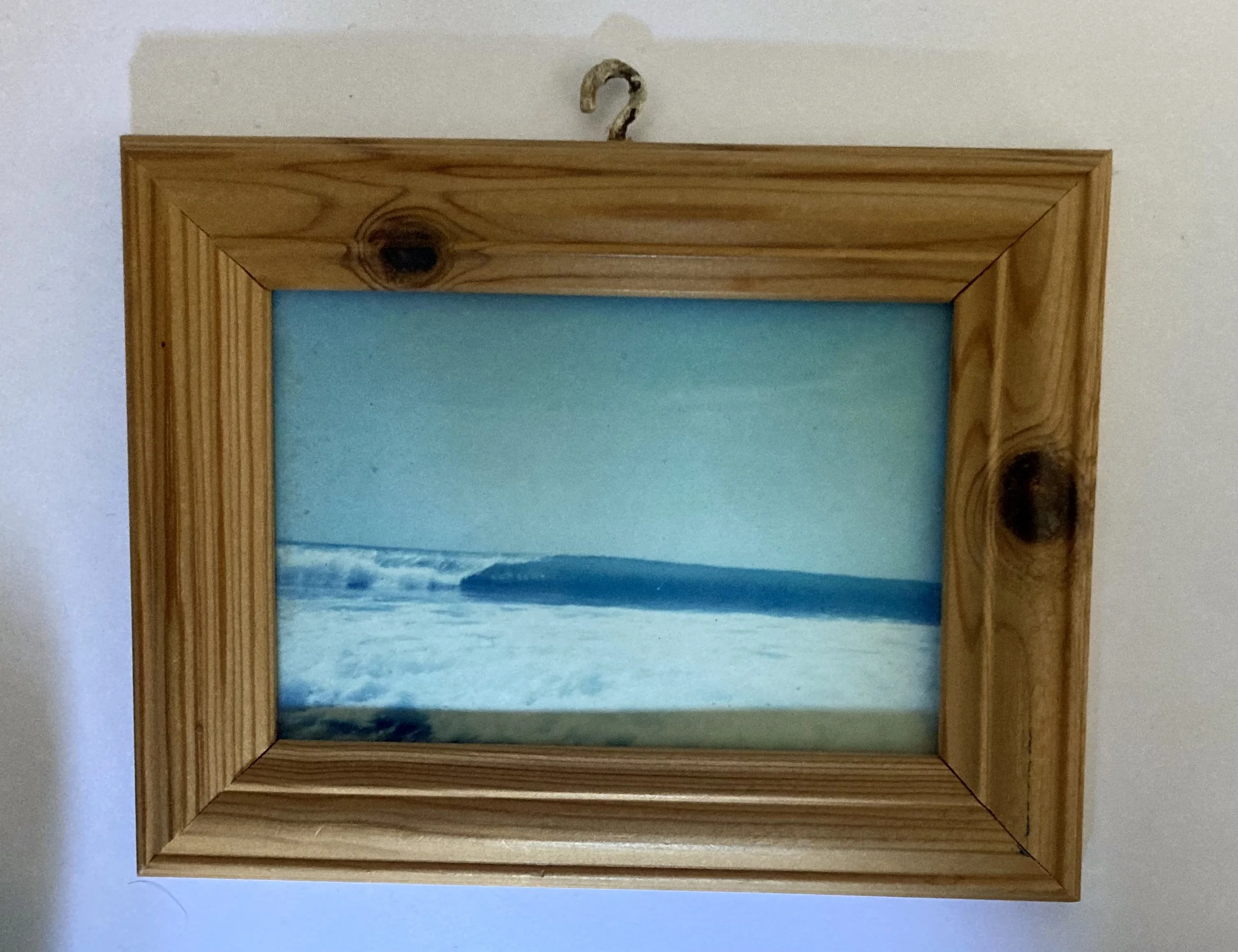
wave-riding lives, my younger brother and I didn't really know anything about surfing, but we did have a couple of polystyrene bodyboards and we spent hours launching ourselves into waves on them, rubbing our bellies raw in the process, this being a time when rash-vests were still unheard-of and a good few years before we got our first wetsuits.
On the whole, the waves on the south coast of Cornwall tend to be small and mushy in the summertime, but on one particular day a strong, long-interval Atlantic pulse somehow found its way to our anonymous little cove and waves the likes of which we'd never seen before started detonating just At this stage in my life I had no real access to the wider surf culture—had never watched a surf film or picked up a surf mag—so I can't have had much of a concept of what a good wave was supposed to look like. I was definitely aware that something magical was happening though, because after watching a few of those exotic, glassy, drainpipe-like visitors peeling across the horizon I ran back up to the top of the beach, put down my little polystyrene bodyboard and picked up the small plastic ‘Flicker’ camera my mum had given me, a freebie for developing her films at Supasnaps. I then ran back into the water and burned through most of a 24-exposure film in just a few minutes. I'm sure that same film was supposed to last the whole trip, but it's a measure of how excited I was by what was unfolding in front of me.
Inevitably, most of the pictures that subsequently came back from the developers were blurry and out of focus. By some miracle though, in one image—taken while wading up to my chest in churning whitewater—I had managed to capture something of the beauty of one of those waves. In an almost-in-focus shot, a head-high turquoise cylinder is peeling across the frame from left to right. The roiling whitewater on the left gives some indication of the power the wave's packing, while the sun is catching a patch of water just beneath the falling lip, hinting at the watery hollow of an impossible-to-make tube. I was so delighted with that picture that I put it in a little wooden frame and hung it on my bedroom wall back at home, and I've kept it with me ever since, an artefact that still brings to life a sliver of memory from a day I've otherwise completely forgotten. As Teju Cole says, again in his essay ‘Memories of Things Unseen’: “Photography is inescapably a memorial art. It selects, out of the flow of time, a moment to be preserved, with the moments before and after falling away like sheer cliffs.” [4]
*
What's particularly flukey about my childhood surf picture is that it captures what's sometimes referred to as a ‘peak moment’. If I'd pressed the shutter button a second earlier, the wave wouldn't have been breaking at all; a second or two later, it would just have been a big wall of whitewater.
These days, the camera I mostly take surf photos with shoots at a rate of 6.5 frames per second. Capturing a peak moment is usually just a case of anticipating roughly when a wave's going to break, firing off a whole sequence of images and then picking a winner when I'm back at home in front of my PC more of an editing task than an in-the-moment photography task. With my little plastic point-and-shoot, by contrast, I had to wind the film on after every frame, so every wave was a one-shot opportunity. Whatever the equipment being used, though, the concept of the peak moment is one of the keys to understanding surf photos.
When it comes to an action shot of a surfer riding a wave, the peak moment is usually the instant of maximum drama: the surfer captured fully extended at the apex of a turn, say, or at the critical point of a tube ride where their chances of making it out from under the falling lip are finely poised at 50-50. Judging the peak moment of a breaking wave, however, can be more complex. The best pictures of empty waves invite you to mind-surf them that is, project yourself into the image and imagine how you'd surf the wave. But different surfers will have different styles, and consequently look for different things in an ideal wave. Show a group of surfers a sequence of images of a wave in the process of breaking, and they'll all have a very definite view of which is the best image in the set. Chances are, though, that there will be at least some disagreement.
All of this suggests that when a surfer shares a picture of an empty wave on social media, they aren't just showing off a quick snap, arbitrarily chosen but a carefully-selected moment, an image picked from a sequence of perhaps a dozen similar images which may itself be one of a dozen similar sequences. So, I wonder, thinking about this now, when a surfer posts a picture of a wave online—one of the many hundreds—are they in fact telling us something fairly fundamental about their sense of surfing aesthetics, exposing a little of their surfing DNA?
*
Perhaps, but also perhaps not. In his book The Social Photo: On Photography and Social Media, Nathan Jurgenson suggests that concentrating on the ‘thingness of the photograph’ is an outdated way of looking at photography. ‘Our collective understanding of what a photograph means has yet to catch up [with social media],’ he writes. ‘Traditional analyses of photography fixate on the photo object. This is the thingness of the photograph, as a discrete something with borders... The thingness of the social media image is undoubtedly still interesting, but its status as an object is not as central; the what and how of a social photo is less important than the why. As [José] van Dijk puts it, young people “take less interest in sharing photographs as objects than as sharing them as experiences.”’ ‘Images within the social stream evoke more than they explain,’ Jurgenson continues, ‘they transmit a general alertness to experience rather than facts. This is what happens when photography is oriented more towards the normal than the exceptional and becomes woven through the contours of everyday life.’ [5]
So perhaps we shouldn't try to read too much into all the surf photos on social media. And yet, and yet... sometimes it is possible for two surfers to reach a degree of mutual understanding just through a picture of a wave and not much else. On a good day of swell on a recent trip to the north coast of Scotland, I'd burned myself out with a morning surf and an afternoon surf so didn't have any gas left in the tank by the evening when the wind swung offshore and—in defiance of the forecast—the waves were actually at their best. Instead of getting back into my wetsuit, I took my camera for a walk up the beach and snapped some pictures of the water. My success rate as a 48-year-old isn't much better than it was when I was nine. In fact, statistically it's probably a lot worse than one good frame in every 24. Still, I did manage to get one picture I was pleased with in about an hour of wandering: a mellow shoulder-high peak looking equally enticing both left and right, with the evening sunlight just catching the feathering lip-line and the snow-capped mountains in the background. There's nothing particularly edgy or pulse-raising about the wave. All it really offers is a nice, leisurely drop-in, perhaps followed by a cruisy turn or two; but for a surfer of my age and stage it's about as good as it gets.
A few days later, a middle-aged surfer friend asked me how my trip had been so I sent him the picture with a note explaining that we'd had a few bigger days but also ‘a couple of geezer-friendly days like this one for my elderly knees.’ ‘That's my kinda surf. Perfect.’ he replied.
Roger Cox is the Arts and Books Editor of The Scotsman. He has been writing about surfing in The Scotsman since 2005 and has contributed a weekly outdoors column to the paper since 2009. He is the author of The View from the Shoulder: A Portrait of Scottish Surfing (Arena Sport/Birlinn, 2025).
-
1. Teju Cole, Known and Strange Things (Faber & Faber, 2016), 181.
2. Cole, Known and Strange Things, 197.
3. Geoff Dyer, The Ongoing Moment (Little, Brown, 2005), 254.
4. Cole, Known and Strange Things, 199.
5. Nathan Jurgenson, The Social Photo (Verso, 2019), 15.